
Calculus Optimization Methods
 |
A reader requests expansion of this book to include more material. You can help by adding new material (learn how) or ask for assistance in the reading room. |
A key application of calculus is in optimization: finding maximum and minimum values of a function, and which points realize these extrema.
Context[edit | edit source]
Formally, the field of mathematical optimization is called mathematical programming, and calculus methods of optimization are basic forms of nonlinear programming. We will primarily discuss finite-dimensional optimization, illustrating with functions in 1 or 2 variables, and algebraically discussing n variables. We will also indicate some extensions to infinite-dimensional optimization, such as calculus of variations, which is a primary application of these methods in physics.
Techniques[edit | edit source]
Basic techniques include the first and second derivative test, and their higher-dimensional generalizations.
A more advanced technique is Lagrange multipliers, and generalizations as Karush–Kuhn–Tucker conditions and Lagrange multipliers on Banach spaces.
Applications[edit | edit source]
Optimization, particularly via Lagrange multipliers, is particularly used in the following fields:
- Physics
- Particularly the Lagrangian formulation of classical mechanics.
- Neoclassical economics
- In neoclassical economics, many problems have been framed as maximization problems following the very influential 1947 text Foundations of Economic Analysis, by Paul Samuelson.
Further, several areas of mathematics can be understood as generalizations of these methods, notably Morse theory and calculus of variations.
Terminology[edit | edit source]
- Input points, output values
- Maxima, minima, extrema, optima
- Stationary point, critical point; stationary value, critical value
- Objective function
- Constraints – equality and inequality
- Especially sublevel sets
- Feasible region, whose points are candidate solutions
Statement[edit | edit source]
This tutorial presents an introduction to optimization problems that involve finding a maximum or a minimum value of an objective function subject to a constraint of the form .


Maximum and minimum[edit | edit source]
Finding optimum values of the function without a constraint is a well known problem dealt with in calculus courses. One would normally use the gradient to find stationary points. Then check all stationary and boundary points to find optimum values.
Example[edit | edit source]



has one stationary point at (0,0).

The Hessian[edit | edit source]
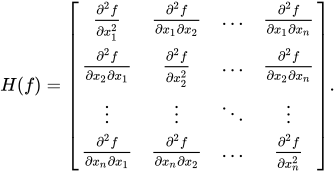
A common method of determining whether or not a function has an extreme value at a stationary point is to evaluate the hessian of the function at that point. where the hessian is defined as
Second derivative test[edit | edit source]
The Second derivative test determines the optimality of stationary point according to the following rules [2]:

- If at point x then has a local minimum at x
- If at point x then has a local maximum at x
- If has negative and positive eigenvalues then x is a saddle point
- Otherwise the test is inconclusive


In the above example.
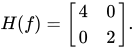
Therefore has a minimum at (0,0).
Sections[edit | edit source]
- Optimization on a Finite Set
- Optimization on an Interval
- Optimization on a Cube
- Constrained Optimization
- Lagrange Multipliers
References[edit | edit source]
- [1] T.K. Moon and W.C. Stirling. Mathematical Methods and Algorithms for Signal Processing. Prentice Hall. 2000.
- [2]http://www.ece.tamu.edu/~chmbrlnd/Courses/ECEN601/ECEN601-Chap3.pdf