Calculus/Kinematics
< Calculus
Introduction[edit | edit source]
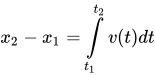
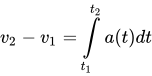
Kinematics or the study of motion is a very relevant topic in calculus.
If is the position of some moving object, and is time, this section uses the following conventions:


- is its position function
- is its velocity function
- is its acceleration function


Differentiation[edit | edit source]
Average Velocity and Acceleration[edit | edit source]
Average velocity and acceleration problems use the algebraic definitions of velocity and acceleration.


Examples[edit | edit source]
Example 1:
A particle's position is defined by the equation . Find the average velocity over the interval .

![{\displaystyle [2,7]}](https://wikimedia.org/api/rest_v1/media/math/render/svg/9fa1ee05ddb9b84241f00541215dc6dd6467ac76)
- Find the average velocity over the interval :

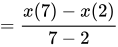


Answer: .

Instantaneous Velocity and Acceleration[edit | edit source]
Instantaneous velocity and acceleration problems use the derivative definitions of velocity and acceleration.


Examples[edit | edit source]
Example 2:
A particle moves along a path with a position that can be determined by the function . Determine the acceleration when .
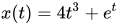

- Find .

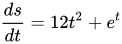
- Find .
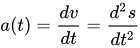
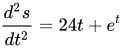
- Find
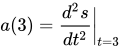

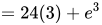


Answer: