Calculus/Functions
Functions are everywhere, from a simple correlation between distance and time to complex heat waves. This chapter focuses on the fundamentals of functions: the definition, basic concepts, and other defining aspects. It is very concept-heavy, and expect a lot of reading and understanding. However, this is simply a review and an introduction on what is to come in future chapters.
Introduction[edit | edit source]
An easy but vague way to understand functions is, to remember that a function i is like a processor. It takes the input to change the output. Formally, a function f from a set X to a set Y is defined by a set G of ordered pairs (x, y) such that x ∈ X, y ∈ Y, and every element of X is the first component of exactly one ordered pair in G. In other words, for every x in X, there is exactly one element y such that the ordered pair (x, y) belongs to the set of pairs defining the function f. The set G is called the graph of the function. Formally speaking, it may be identified with the function, but this hides the usual interpretation of a function as a process. Therefore, in common usage, the function is generally distinguished from its graph.
Whenever one quantity uniquely determines the value of another quantity, we have a function. That is, the set uniquely determines the set . You can think of a function as a kind of machine. You feed the machine raw materials, and the machine changes the raw materials into a finished product.


|
A function in everyday life Think about dropping a ball from a bridge. At each moment in time, the ball is a height above the ground. The height of the ball is a function of time. It was the job of physicists to come up with a formula for this function. This type of function is called real-valued since the "finished product" is a number (or, more specifically, a real number). |
|
A function in everyday life (Preview of Multivariable Calculus) Think about a wind storm. At different places, the wind can be blowing in different directions with different intensities. The direction and intensity of the wind can be thought of as a function of position. This is a function of two real variables (a location is described by two values - an and a ) which results in a vector (which is something that can be used to hold a direction and an intensity). These functions are studied in multivariable calculus (which is usually studied after a one year college level calculus course). This a vector-valued function of two real variables. |


We will be looking at real-valued functions until studying multivariable calculus. Think of a real-valued function as an input-output machine; you give the function an input, and it gives you an output which is a number (more specifically, a real number). For example, the squaring function takes the input 4 and gives the output value 16. The same squaring function takes the input -1 and gives the output value 1.


Notation[edit | edit source]
Functions are used so much that there is a special notation for them. The notation is somewhat ambiguous, so familiarity with it is important in order to understand the intention of an equation or formula.
Though there are no strict rules for naming a function, it is standard practice to use the letters , , and to denote functions, and the variable to denote an independent variable. is used for both dependent and independent variables.


When discussing or working with a function , it's important to know not only the function, but also its independent variable . Thus, when referring to a function , you usually do not write , but instead . The function is now referred to as " of ". The name of the function is adjacent to the independent variable (in parentheses). This is useful for indicating the value of the function at a particular value of the independent variable. For instance, if
- ,
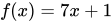
and if we want to use the value of for equal to , then we would substitute 2 for on both sides of the definition above and write


This notation is more informative than leaving off the independent variable and writing simply '' , but can be ambiguous since the parentheses next to can be misinterpreted as multiplication, . To make sure nobody is too confused, follow this procedure:

- Define the function by equating it to some expression.
- Give a sentence like the following: "At , the function is..."
- Evaluate the function.

Description[edit | edit source]
There are many ways which people describe functions. In the examples above, a verbal description is given (the height of the ball above the earth as a function of time). Here is a list of ways to describe functions. The top three listed approaches to describing functions are the most popular.
- A function is given a name (such as ) and a formula for the function is also given. For example, describes a function. We refer to the input as the argument of the function (or the independent variable), and to the output as the value of the function at the given argument.
- A function is described using an equation and two variables. One variable is for the input of the function and one is for the output of the function. The variable for the input is called the independent variable. The variable for the output is called the dependent variable. For example, describes a function. The dependent variable appears by itself on the left hand side of equal sign.
- A verbal description of the function.
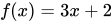

When a function is given a name (like in number 1 above), the name of the function is usually a single letter of the alphabet (such as or ). Some functions whose names are multiple letters (like the sine function )

|
Plugging a value into a function If we write , then we know that
How would we know the value of the function at 3? We would have the following three thoughts: and we would write . The value of at 3 is 11. Note that means the value of the dependent variable when takes on the value of 3. So we see that the number 11 is the output of the function when we give the number 3 as the input. People often summarize the work above by writing "the value of at three is eleven", or simply " of three equals eleven". |




Basic concepts of functions[edit | edit source]
The formal definition of a function states that a function is actually a mapping that associates the elements of one set called the domain of the function, , with the elements of another set called the range of the function, . For each value we select from the domain of the function, there exists exactly one corresponding element in the range of the function. The definition of the function tells us which element in the range corresponds to the element we picked from the domain. An example of how is given below.


|
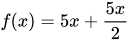
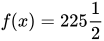
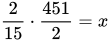
Let function for all . For what value of gives ? In mathematics, it is important to notice any repetition. If something seems to repeat, keep a note of that in the back of your mind somewhere. Here, notice that and . Because is equal to two different things, it must be the case that the other side of the equal sign to is equal to the other. This property is known as the transitive property and could thus make the following equation below true: Next, simplify — make your life easier rather than harder. In this instance, since has as a like-term, and the two terms are fractions added to the other, put it over a common denominator and simplify. Similar, since is a mixed fraction, . Multiply both sides by the reciprocal of the coefficient of , from both sides by multiplying by it.
The value of that makes is .. |
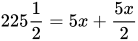


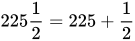
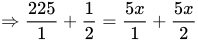

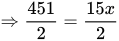



Classically, the element picked from the domain is pictured as something that is fed into the function and the corresponding element in the range is pictured as the output. Since we "pick" the element in the domain whose corresponding element in the range we want to find, we have control over what element we pick and hence this element is also known as the "independent variable". The element mapped in the range is beyond our control and is "mapped to" by the function. This element is hence also known as the "dependent variable", for it depends on which independent variable we pick. Since the elementary idea of functions is better understood from the classical viewpoint, we shall use it hereafter. However, it is still important to remember the correct definition of functions at all times.
Basic types of transformation[edit | edit source]
To make it simple, for the function , all of the possible values constitute the domain, and all of the values ( on the x-y plane) constitute the range. To put it in more formal terms, a function is a mapping of some element , called the domain, to exactly one element , called the range, such that . The image below should help explain the modern definition of a function:


- A function is considered one-to-one if an element from domain of function , leads to exactly one element from range of the function. By definition, since only one element is mapped by function from some element , implies that there exists only one element from the mapping. Therefore, there exists a one-to-one function because it complies with the definition of a function. This definition is similar to Figure 1.
- A function is considered many-to-one if some elements from domain of function maps to exactly one element from range of the function. Since some elements must map onto exactly one element , must be compliant with the definition of a function. Therefore, there exists a many-to-one function.
- A function is considered one-to-many if exactly one element from domain of function maps to some elements from range of the function. If some element maps onto many distinct elements , then is non-functional since there exists many distinct elements . Given many-to-one is non-compliant to the definition of a function, there exists no function that is one-to-many.





The modern definition describes a function sufficiently such that it helps us determine whether some new type of "function" is indeed one. Now that each case is defined above, you can now prove whether functions are one of these function cases. Here is an example problem:
|
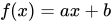
Given: , where and are constant and . Prove: function is one-to-one. Notice that the only changing element in the function is . To prove a function is one-to-one by applying the definition may be impossible because although two random elements of domain set may not be many-to-one, there may be some elements that may make the function many-to-one. To account for this possibility, we must prove that it is impossible to have some result like that.
Assume there exists two distinct elements that will result in . This would make the function many-to-one. In consequence, Subtract from both sides of the equation. Subtract from both sides of the equation. Factor from both terms to the left of the equation. Multiply to both sides of the equation. Add to both sides of the equation. |













Basic concepts[edit | edit source]

There are a few more important ideas to learn from the modern definition of the function, and it comes from knowing the difference between domain, range, and codomain. We already discussed some of these, yet knowing about sets adds a new definition for each of the following ideas. Therefore, let us discuss these based on these new ideas. Let and be a set. If we were to combine these two sets, it would be defined as the cartesian cross product . The subset of this product is the function. The below definitions are a little confusing. The best way to interpret these is to draw an image. To the right of these definitions is the image that corresponds to it.

The domain is defined to be a set with all elements mapping to at least one unique .
The set of elements in is the range of the function mapping in the cartesian cross product, whereby the set of all elements maps to some element .
The codomain is the set , where it is not necessarily the case that all elements was mapped by some .
Note that the codomain is not as important as the other two concepts.
Take for example:
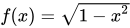

Because of the square root, the content in the square root should be strictly not smaller than 0.


Thus the domain is
![{\displaystyle x\in [-1,1]}](https://wikimedia.org/api/rest_v1/media/math/render/svg/1f9d0dda56ce3e01e14570ac9aef0021c6125722)

Correspondingly, the range will be
![{\displaystyle f(x)\in [0,1]}](https://wikimedia.org/api/rest_v1/media/math/render/svg/99f503c443788a9b9f65ff7a48589ce6fd1965d6)
Other types of transformation[edit | edit source]
There is one more final aspect that needs to be defined. We already have a good idea of what makes a mapping a function (e.g. it cannot be one-to-many). However, three more definitions that you will often hear will be necessary to talk about: injective, surjective, bijective.

- A function is injective if it is one-to-one.
- A function is surjective if it is "onto." That is, the mapping has as the range of the function, where the codomain and the range of the function are the same.
- A function is bijective if it is both surjective and injective.
Again, the above definitions are often very confusing. Again, another image is provided to the right of the bullet points. Along with that, another example is also provided. Let us analyze the function .

|
Given: , where is constant and . Prove: function is non-surjective and non-injective. Notice that the only changing element in the function is . Let us check to see the conditions of this function.
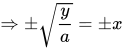
Is it injective? Let , and solve for . First, divide by . Then take the square root of . By definition, , so Notice, however, what we learned from the above manipulation. As a result of solving for , we found that there are two solutions for . However, this resulted in two different values from . This means that for some individual that gives , there are two different inputs that result in the same value. Because when , this is by definition non-injective. Is it surjective? As a natural consequence of what we learned about inputs, let us determine the range of the function. After all, the only way to determine if something is surjective is to see if the range applies to all real numbers. A good way to determine this is by finding a pattern involving our domains. Let us say we input a negative number for the domain: . This seemingly trivial exercise tells us that negative numbers give us non-negative numbers for our range. This is huge information! For , the function always results for our range. For the set , we have elements in that set that have no mappings from the set . As such, is the codomain of set . Therefore, this function is non-surjective! |







Tests for equations[edit | edit source]
The vertical line test[edit | edit source]
The vertical line test is a systematic test to find out if an equation involving and can serve as a function (with the independent variable and the dependent variable). Simply graph the equation and draw a vertical line through each point of the -axis. If any vertical line ever touches the graph at more than one point, then the equation is not a function; if the line always touches at most one point of the graph, then the equation is a function.
The circle, on the right, is not a function because the vertical line intercepts two points on the graph when .

The horizontal line and the algebraic 1-1 test[edit | edit source]
Similarly, the horizontal line test, though does not test if an equation is a function, tests if a function is injective (one-to-one). If any horizontal line ever touches the graph at more than one point, then the function is not one-to-one; if the line always touches at most one point on the graph, then the function is one-to-one.
The algebraic 1-1 test is the non-geometric way to see if a function is one-to-one. The basic concept is that:
Assume there is a function . If:
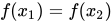
, and , then


function is one-to-one.
Here is an example: prove that is injective.
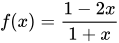
Since the notation is the notation for a function, the equation is a function. So we only need to prove that it is injective. Let and be the inputs of the function and that . Thus,
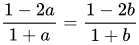





So, the result is , proving that the function is injective.
Another example is proving that is not injective.

Using the same method, one can find that , which is not . So, the function is not injective.

Remarks[edit | edit source]
The following arise as a direct consequence of the definition of functions:
- By definition, for each "input" a function returns only one "output", corresponding to that input. While the same output may correspond to more than one input, one input cannot correspond to more than one output. This is expressed graphically as the vertical line test: a line drawn parallel to the axis of the dependent variable (normally vertical) will intersect the graph of a function only once. However, a line drawn parallel to the axis of the independent variable (normally horizontal) may intersect the graph of a function as many times as it likes. Equivalently, this has an algebraic (or formula-based) interpretation. We can always say if , then , but if we only know that then we can't be sure that .
- Each function has a set of values, the function's domain, which it can accept as input. Perhaps this set is all positive real numbers; perhaps it is the set {pork, mutton, beef}. This set must be implicitly/explicitly defined in the definition of the function. You cannot feed the function an element that isn't in the domain, as the function is not defined for that input element.
- Each function has a set of values, the function's range, which it can output. This may be the set of real numbers. It may be the set of positive integers or even the set {0,1}. This set, too, must be implicitly/explicitly defined in the definition of the function.
Functions are an important foundation of mathematics. This modern interpretation is a result of the hard work of the mathematicians of history. It was not until recently that the definition of the relation was introduced by René Descartes in Geometry (1637). Nearly a century later, the standard notation () was first introduced by Leonhard Euler in Introductio in Analysin Infinitorum and Institutiones Calculi Differentialis. The term function was also a new innovation during Euler's time as well, being introduced Gottfried Wilhelm Leibniz in a 1673 letter "to describe a quantity related to points of a curve, such as a coordinate or curve's slope." Finally, the modern definition of the function being the relation among sets was first introduced in 1908 by Godfrey Harold Hardy where there is a relation between two variables and such that "to some values of at any rate correspond values of ." For the person that wants to learn more about the history of the function, go to History of functions.

Important functions[edit | edit source]
The functions listed below are essential to calculus. This section only serves as a review and scratches the surface of those functions. If there are any questions about those functions, please review the materials related to those functions before continuing. More about graphing will be explained in Chapter 1.4
Polynomials[edit | edit source]
Polynomial functions are the most common and most convenient functions in the world of calculus. Their frequent appearances and their applications on computer calculations have made them important.
A polynomial in a single indeterminate x can always be written (or rewritten) in the form:

To be more concise, it can also be written in the summation form:

Constant[edit | edit source]

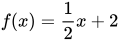

When , the polynomial can be rewritten into the following function:

, where is a constant.


The graph of this function is a horizontal line passing the point .

Linear[edit | edit source]
When , the polynomial can be rewritten into

, where are constants.


The graph of this function is a straight line passing the point and , and the slope of this function is .


Quadratic[edit | edit source]
When , the polynomial can be rewritten into

, where are constants.


The graph of this function is a parabola, like the trajectory of a basketball thrown into the hoop.
If there are questions about the quadratic formula and other basic polynomial concepts, please review the respective chapters in Algebra.
Trigonometric[edit | edit source]
Trigonometric functions are also very important because it can connect algebra and geometry. Trigonometric functions are explained in detail here due to its importance and difficulty.

Exponential and Logarithmic[edit | edit source]
Exponential and logarithmic functions have a unique identity when calculating the derivatives, so this is a great time to review those functions.
The exponential function is defined as:
- , where is a constant.

while the logarithmic function is defined as:
- , where is a constant.
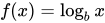
A special number will be frequently seen in those functions: the Euler's constant, also known as the base of the natural logarithm. Notated as , it is defined as .


Signum[edit | edit source]
The Signum (sign) function is simply defined as
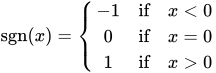
Properties of functions[edit | edit source]
Sometimes, a lot of function manipulations cannot be achieved without some help from basic properties of functions.
Domain and range[edit | edit source]
This concept is discussed above.
Growth[edit | edit source]
Although it seems obvious to spot a function increasing or decreasing, without the help of graphing software, we need a mathematical way to spot whether the function is increasing or decreasing, or else our human minds cannot immediately comprehend the huge amount of information.
Assume a function with inputs , and that , , and at all times.

![{\displaystyle x_{1}\in [a,b]}](https://wikimedia.org/api/rest_v1/media/math/render/svg/0f03ee615e7879f20efa45f3c3c6296c14b53995)
![{\displaystyle x_{2}\in [a,b]}](https://wikimedia.org/api/rest_v1/media/math/render/svg/e93c068e15bd53700224ed82f922c758216ee03e)

If for all and , , then
is increasing in
If for all and , , then
is decreasing in

![{\displaystyle [a,b]}](https://wikimedia.org/api/rest_v1/media/math/render/svg/9c4b788fc5c637e26ee98b45f89a5c08c85f7935)

Example: In which intervals is increasing?
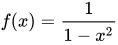
Firstly, the domain is important. Because the denominator cannot be 0, the domain for this function is

In , the growth of the function is:

Let and Thus,
both
and
So,
is decreasing in
![{\displaystyle x_{1},x_{2}\in [-\infty ,-1]}](https://wikimedia.org/api/rest_v1/media/math/render/svg/0cf5c7151b951ae1ff019d7e81b7649743e9a8ac)






In

Let and Thus,
both
However, the sign of in cannot be determined. It can only be determined in .
In
and
In
As a result, is decreasing in and increasing in .
![{\displaystyle x_{1},x_{2}\in [-1,1]}](https://wikimedia.org/api/rest_v1/media/math/render/svg/8ed87fe12ce57afdf247fb00036ed2503255e93f)



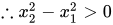
In

Let and Thus,
both
So,
is increasing in .
![{\displaystyle x_{1},x_{2}\in [1,\infty ]}](https://wikimedia.org/api/rest_v1/media/math/render/svg/740ee44dae32033ccc8b24018acf55e6c11fa60a)

Therefore, the intervals in which the function is increasing are .
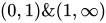
After learning derivatives, there will be more ways to determine the growth of a function.
Parity[edit | edit source]
The properties odd and even are associated with symmetry. While even functions have a symmetry about the -axis, odd functions are symmetric about the origin. In mathematical terms:
A function is even when A function is odd when
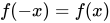

Example: Prove that is an even function.

is an even function

Manipulating functions[edit | edit source]
Addition, Subtraction, Multiplication and Division of functions[edit | edit source]
For two real-valued functions, we can add the functions, multiply the functions, raised to a power, etc.
|
Example: Adding, subtracting, multiplying and dividing functions which do not have a name If we add the functions and , we obtain . If we subtract from , we obtain . We can also write this as . If we multiply the function and the function , we obtain . We can also write this as . If we divide the function by the function , we obtain . |




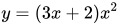
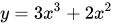

If a math problem wants you to add two functions and , there are two ways that the problem will likely be worded:
- If you are told that , that , that and asked about , then you are being asked to add two functions. Your answer would be .
- If you are told that , that and you are asked about , then you are being asked to add two functions. The addition of and is called . Your answer would be .




Similar statements can be made for subtraction, multiplication and division.
|
Example: Adding, subtracting, multiplying and dividing functions which do have a name Let and: . Let's add, subtract, multiply and divide.
|
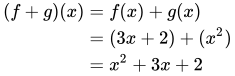
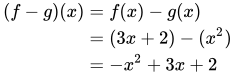
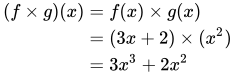
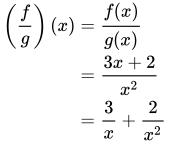
Composition of functions[edit | edit source]
We begin with a fun (and not too complicated) application of composition of functions before we talk about what composition of functions is.
|
Example: Dropping a ball If we drop a ball from a bridge which is 20 meters above the ground, then the height of our ball above the earth is a function of time. The physicists tell us that if we measure time in seconds and distance in meters, then the formula for height in terms of time is . Suppose we are tracking the ball with a camera and always want the ball to be in the center of our picture. Suppose we have The angle will depend upon the height of the ball above the ground and the height above the ground depends upon time. So the angle will depend upon time. This can be written as . We replace with what it is equal to. This is the essence of composition. |



Composition of functions is another way to combine functions which is different from addition, subtraction, multiplication or division.
The value of a function depends upon the value of another variable ; however, that variable could be equal to another function , so its value depends on the value of a third variable. If this is the case, then the first variable is a function of the third variable; this function () is called the composition of the other two functions ( and ).
|
Example: Composing two functions Let and: . The composition of with is read as either "f composed with g" or "f of g of x." Let Then
Sometimes a math problem asks you compute when they want you to compute , Here, is the composition of and and we write . Note that composition is not commutative:
|

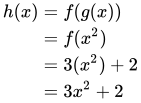



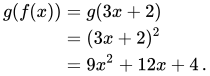

Composition of functions is very common, mainly because functions themselves are common. For instance, squaring and sine are both functions:


Thus, the expression is a composition of functions:



(Note that this is not the same as .) Since the function sine equals if ,



- .

Since the function square equals if ,

- .

Transformations[edit | edit source]
Transformations are a type of function manipulation that are very common. They consist of multiplying, dividing, adding or subtracting constants to either the input or the output. Multiplying by a constant is called dilation and adding a constant is called translation. Here are a few examples:
- Dilation
- Translation
- Dilation
- Translation


Translations and dilations can be either horizontal or vertical. Examples of both vertical and horizontal translations can be seen at right. The red graphs represent functions in their 'original' state, the solid blue graphs have been translated (shifted) horizontally, and the dashed graphs have been translated vertically.
Dilations are demonstrated in a similar fashion. The function
has had its input doubled. One way to think about this is that now any change in the input will be doubled. If I add one to , I add two to the input of , so it will now change twice as quickly. Thus, this is a horizontal dilation by because the distance to the -axis has been halved. A vertical dilation, such as

is slightly more straightforward. In this case, you double the output of the function. The output represents the distance from the -axis, so in effect, you have made the graph of the function 'taller'. Here are a few basic examples where is any positive constant:
| Original graph | Rotation about origin | ||
| Horizontal translation by units left | Horizontal translation by units right | ||
| Horizontal dilation by a factor of | Vertical dilation by a factor of | ||
| Vertical translation by units down | Vertical translation by units up | ||
| Reflection about -axis | Reflection about -axis |


Inverse functions[edit | edit source]
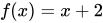
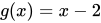
We call the inverse function of if, for all :


A function has an inverse function if and only if is one-to-one. For example, the inverse of is . The function has no inverse because it is not injective. Similarly, the inverse functions of trigonometric functions have to undergo transformations and limitations to be considered as valid functions.
Notation[edit | edit source]
The inverse function of is denoted as . Thus, is defined as the function that follows this rule


To determine when given a function , substitute for and substitute for . Then solve for , provided that it is also a function.
Example: Given , find .
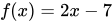
Substitute for and substitute for . Then solve for :
![{\displaystyle \Leftrightarrow x=2[f^{-1}(x)]-7}](https://wikimedia.org/api/rest_v1/media/math/render/svg/d823629e07ebfdf4e31604db723251807f12fd12)
![{\displaystyle \Leftrightarrow x+7=2[f^{-1}(x)]}](https://wikimedia.org/api/rest_v1/media/math/render/svg/5ef00069307c01d1d32178da59bf982da21648af)
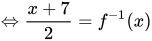
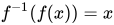
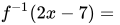
To check your work, confirm that :

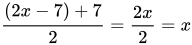
If isn't one-to-one, then, as we said before, it doesn't have an inverse. Then this method will fail.
Example: Given , find .

Substitute for and substitute for . Then solve for :
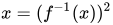
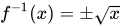
Since there are two possibilities for , it's not a function. Thus doesn't have an inverse. Of course, we could also have found this out from the graph by applying the Horizontal Line Test. It's useful, though, to have lots of ways to solve a problem, since in a specific case some of them might be very difficult while others might be easy. For example, we might only know an algebraic expression for but not a graph.