Calculus/Formal Definition of the Limit


In preliminary calculus, the concept of a limit is probably the most difficult one to grasp (after all, it took mathematicians 150 years to arrive at it); it is also the most important and most useful one.
The intuitive definition of a limit is inadequate to prove anything rigorously about it. The problem lies in the vague term "arbitrarily close". We discussed earlier that the meaning of this term is that the closer gets to the specified value, the closer the function must get to the limit, so that however close we want the function to the limit, we can accomplish this by making sufficiently close to our value. We can express this requirement technically as follows:
Let be a function defined on an open interval that contains , except possibly at . Let be a number. Then we say that


if, for every , there exists a such that for all with



we have
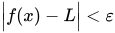
To further explain, earlier we said that "however close we want the function to the limit, we can find a corresponding close to our value." Using our new notation of epsilon () and delta (), we mean that if we want to make within of , the limit, then we know that making within of puts it there.
Again, since this is tricky, let's resume our example from before: , at . To start, let's say we want to be within .01 of the limit. We know by now that the limit should be 4, so we say: for , there is some so that as long as , then .


To show this, we can pick any that is bigger than 0, so long as it works. For example, you might pick , because you are absolutely sure that if is within of 2, then will be within of 4. This works for . But we can't just pick a specific value for , like 0.01, because we said in our definition "for every ." This means that we need to be able to show an infinite number of s, one for each . We can't list an infinite number of s!


Of course, we know of a very good way to do this; we simply create a function, so that for every , it can give us a . In this case, one definition of that works is (see example 5 in choosing delta for an explanation of how this delta was chosen.)
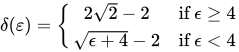
So, in general, how do you show that tends to as tends to ? Well imagine somebody gave you a small number (e.g., say ). Then you have to find a and show that whenever we have . Now if that person gave you a smaller (say ) then you would have to find another , but this time with 0.03 replaced by 0.002. If you can do this for any choice of then you have shown that tends to as tends to . Of course, the way you would do this in general would be to create a function giving you a for every , just as in the example above.


Formal Definition of the Limit at Infinity[edit | edit source]
We call the limit of as approaches if for every number there exists a such that whenever we have


When this holds we write
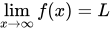
or
- as


Similarly, we call the limit of as approaches if for every number , there exists a number such that whenever we have


When this holds we write
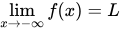
or
- as

Notice the difference in these two definitions. For the limit of as approaches we are interested in those such that . For the limit of as approaches we are interested in those such that .
Examples[edit | edit source]
Here are some examples of the formal definition.
- Example 1
We know from earlier in the chapter that

What is when for this limit?
We start with the desired conclusion and substitute the given values for and :
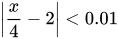
Then we solve the inequality for :

This is the same as saying

(We want the thing in the middle of the inequality to be because that's where we're taking the limit.) We normally choose the smaller of and for , so , but any smaller number will also work.


- Example 2
What is the limit of as approaches 4?
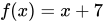
There are two steps to answering such a question; first we must determine the answer — this is where intuition and guessing is useful, as well as the informal definition of a limit — and then we must prove that the answer is right.
In this case, 11 is the limit because we know is a continuous function whose domain is all real numbers. Thus, we can find the limit by just substituting 4 in for , so the answer is .

We're not done, though, because we never proved any of the limit laws rigorously; we just stated them. In fact, we couldn't have proved them, because we didn't have the formal definition of the limit yet, Therefore, in order to be sure that 11 is the right answer, we need to prove that no matter what value of is given to us, we can find a value of such that
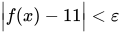
whenever

For this particular problem, letting works (see choosing delta for help in determining the value of to use in other problems). Now, we have to prove

given that

Since , we know


which is what we wished to prove.
- Example 3
What is the limit of as approaches 4?
As before, we use what we learned earlier in this chapter to guess that the limit is . Also as before, we pull out of thin air that


Note that, since is always positive, so is , as required. Now, we have to prove
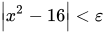
given that
- .

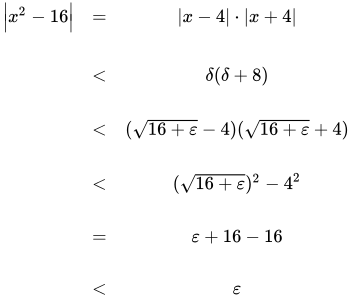
We know that

(because of the triangle inequality), so
- Example 4
Show that the limit of as approaches 0 does not exist.

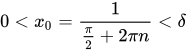
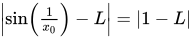
We will proceed by contradiction. Suppose the limit exists; call it . For simplicity, we'll assume that ; the case for is similar. Choose . Then if the limit were there would be some such that for every with . But, for every , there exists some (possibly very large) such that , but , a contradiction.


- Example 5
What is the limit of as approaches 0?

By the Squeeze Theorem, we know the answer should be 0. To prove this, we let . Then for all , if , then as required.

- Example 6
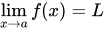
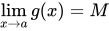
Suppose that and . What is ?
![{\displaystyle \lim _{x\to a}{\big [}f(x)+g(x){\big ]}}](https://wikimedia.org/api/rest_v1/media/math/render/svg/38060b7158f65e3a3b93578e271e872b054a8682)
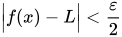
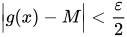
Of course, we know the answer should be , but now we can prove this rigorously. Given some , we know there's a such that, for any with , (since the definition of limit says "for any ", so it must be true for as well). Similarly, there's a such that, for any with , . We can set to be the lesser of and . Then, for any with , , as required.








If you like, you can prove the other limit rules too using the new definition. Mathematicians have already done this, which is how we know the rules work. Therefore, when computing a limit from now on, we can go back to just using the rules and still be confident that our limit is correct according to the rigorous definition.
Formal Definition of a Limit Being Infinity[edit | edit source]
Let be a function defined on an open interval that contains , except possibly at . Then we say that
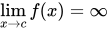
if, for every , there exists a such that for all with
we have
- .

When this holds we write
or
- as


Similarly, we say that
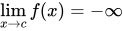
if, for every , there exists a such that for all with
we have
- .

When this holds we write
or
- as .
