Calculus/Finite Limits
Informal Finite Limits[edit | edit source]
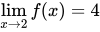
Now, we will try to more carefully restate the ideas of the last chapter. We said then that the equation meant that, when gets close to 2, gets close to 4. What exactly does this mean? How close is "close"? The first way we can approach the problem is to say that, at , which is pretty close to 4.



Sometimes however, the function might do something completely different. For instance, suppose , so . Next, if you take a value even closer to 2, , in this case you actually move further from 4. The reason for this is that substitution gives us 4.23 as approaches 2.



The solution is to find out what happens arbitrarily close to the point. In particular, we want to say that, no matter how close we want the function to get to 4, if we make close enough to 2 then it will get there. In this case, we will write
and say "The limit of , as approaches 2, equals 4" or "As approaches 2, approaches 4." In general:
We call the limit of as approaches if becomes arbitrarily close to whenever is sufficiently close (and not equal) to .


When this holds we write

or

One-Sided Limits[edit | edit source]
Sometimes, it is necessary to consider what happens when we approach an value from one particular direction. To account for this, we have one-sided limits. In a left-handed limit, approaches from the left-hand side. Likewise, in a right-handed limit, approaches from the right-hand side.

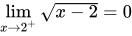
For example, if we consider , there is a problem because there is no way for to approach 2 from the left hand side (the function is undefined here). But, if approaches 2 only from the right-hand side, we want to say that approaches 0.


We call the limit of as approaches from the right if becomes arbitrarily close to whenever is sufficiently close to and greater than .
When this holds we write
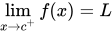
Similarly, we call the limit of as approaches from the left if becomes arbitrarily close to whenever is sufficiently close to and less than .
When this holds we write
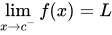
In our example, the left-handed limit does not exist.

The right-handed limit, however, .
It is a fact that exists if and only if and exist and are equal to each other. In this case, will be equal to the same number.


In our example, one limit does not even exist. Thus does not exist either.