Arithmetic/Introduction to Natural Numbers
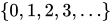
The ability to count things has been essential throughout the ages. Over time, several systems for counting things were developed; the first of which was the natural numbers. As a set, the natural numbers can be written like so: . If we also include the number zero in the set, it becomes the whole numbers: .


Formulation[edit | edit source]
The whole numbers can be formed in many ways. The easiest way is to use what is called an inductive definition. This is when we define the first of a series of numbers, and then make it possible to derive any given number's successor so that given any number we can always find the next. The first of the whole numbers is . The way we can derive the next is to simply add one to the previous number. This is easily demonstrated: , so zero's successor is one; , so one's successor is two; , so two's successor is three; and this can be continued "ad infinitum," which is just a Latin phrase meaning "to infinity".


Uses[edit | edit source]
The natural numbers are used for three main purposes: for counting, for ordering, and for defining other concepts. Counting is the natural way to measure the quantity of a set of several discrete, individually identifiable objects. To count a specific set of objects using the natural numbers, you must simply assign one and only one natural number to one element of the group of objects, starting with one. To the next object, selected arbitrarily, that has not yet been assigned a number, you would assign the next number in the group of natural numbers and then proceed to move on to the next, until all of the items have been assigned a number. (If we can never reach the end, we cannot describe the count in terms of any natural number. There are ways of dealing with "infinite" sets, but for now we stick to "finite" sets.) The attentive will notice that this is an inductive definition: we define the first term and come up with a way of deriving any given term's successor. Counting sometimes goes by the fancy name "enumeration."
Ordering (also called "ranking") is the assignment of natural numbers to members of a group not arbitrarily, but with some property in mind. To do this, you select the object that has the most extreme value of that property (i.e. the smallest, the smartest, the fattest, etc. . .) and assign it the natural number one, then you set it aside and move on to the remaining object with the greatest (remaining) value of that property and assign it the next natural number, in this case, two. You then set it aside too, and proceed to the remaining object with the greatest (remaining) value of that property and assign it, once again, the next natural number, repeating this step until all objects have been ranked. (If we are only interested in the first few rankings, we can stop before we have ranked all of a large number of objects.) Once again, we use an inductive definition. In most natural languages, different words are used for numbers as quantities ("three") and for numbers as ranks ("third"). We call the former "cardinal numbers" and the latter "ordinal numbers," although they are both just natural numbers being applied in slightly different ways.
It should be noted that in all of the above cases zero does not come into play. Zero is a unique case where, in the case of counting, you have not yet assigned any number to an object. For example, if you are attempting to count the amount of apples you own, and you own no apples, then the amount you count is zero. With ordering, the number zero is never used because if you have nothing to order, you are done before you start, and no object will ever be ranked in 0th place.
The natural numbers also play an integral part in the definition of many other mathematical concepts, including the very concept of mathematical induction we have used to define counting and ordering. Because the procedure used on this page uses mathematical induction, in a more formal situation we must use another method to define the natural numbers, in order to avoid a "circular definition" (where a concept is defined in terms that depend on the concept being defined). A formal definition of natural numbers can be based on the "successor" idea.
Properties[edit | edit source]
One notices that the natural numbers go on forever, with any singular one of them having an infinite number of successors, as any successor has a successor, and that successor has a successor onwards to infinity. Yet in spite of the infinite size, we can still count the numbers. This makes the set countably infinite. Mathematicians have created a whole set of special numbers called the cardinal numbers to describe the different sized infinities; in this case, the set of natural numbers is aleph-null sized. This is important to remember for further studies in mathematics.