Algebra/Quadratic Equation
Derivation[edit | edit source]
The solutions to the general-form quadratic function can be given by a simple equation called the quadratic equation. To solve this equation, recall the completed square form of the quadratic equation derived in the previous section:

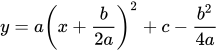
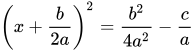
In this case, since we're looking for the root of this function. To solve, first subtract c and divide by a:

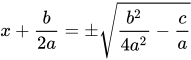
Take the (plus and minus) square root of both sides to obtain:
Subtracting from both sides:

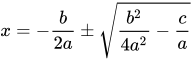
This is the solution but it's in an inconvenient form. Let's rationalize the denominator of the square root:

Now, adding the fractions, the final version of the quadratic formula is:
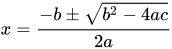
This formula is very useful, and it is suggested that the students memorize it as soon as they can.
Discriminant[edit | edit source]
The part under the radical sign, , is called the discriminant, . The value of the discriminant tells us some useful information about the roots.


- If , there are two unique real solutions.
- If , there is one unique real solution.
- If , there are two unique, conjugate imaginary solutions.
- If is a perfect square then the two solutions are rational, otherwise they are irrational conjugates.


Word Problems[edit | edit source]
Need to pull word problems from http://teachers.yale.edu/curriculum/search/viewer.php?id=initiative_07.06.12_u&skin=h