Algebra/Polynomials
With practice the concept of slope for linear functions becomes intuitive. It makes sense that the line that fits the equation has a steeper ascent then the line that fits the equation . You only have to move horizontally one unit to change your vertical direction two for the former when you graph . How many blocks do you need to move horizontally to change your vertical direction by one for the line ?


When we express concepts like the abstract behavior of what is being represented becomes a little harder to see.

A monomial of one variable, let's say x, is an algabraic expression of the form

where
- is a constant, and
- is a non-negative integer (e.g., 0, 1, 2, 3, ...).


The integer is called the degree of the monomial.
The idea of a monomial of degree zero appears a bit mystical since it always represents one, except when the value of the variable is set equal to zero when the result is undefined. This idea allows us preserve the value of the constant in the monomial. We know that is always equal to because even though we have 0 x's (somethings) we still have a c. When x = 0 things are difficult because the value we started with, 0, represents nothing.

For a monomial of power 1 we are multiplying C by one instance of our variable. When we get . When we are multiplying c by 1 x. If x is less than 1 then c gets smaller, if x is more than 1 c gets bigger. When x is between 0 and -1 c gets smaller slower, when x is less than -1 c gets smaller faster.


A monomial with power two is one that "squares" the value of x. The reference to square is because using the multiplication operation once allows us to measure area. If you have something that is one unit on each side this is called a square unit. If you divide both sides of your square unit in half, you get 4 quarter units. We represent this with math by doing the multiplication Squaring something is a non-intuitive operation until you become comfortable with the graph of the function. We can see this with the story of the mathematician who was offered a reward by his king. The mathematician said he wanted a single grain of wheat, squared every day for 30 days. For the first seven days the king's servants delivered 1, 2, 4, 16, 256, 65,536 grains of wheat to the mathematician. On the seventh day the value was 4,294,967,296 (4 gig in computer terms)... Sometimes the story ends with the king re-negotiating, sometimes the story ends with the king executing the mathematician to preserve his kingdom, and sometimes the king is astute enough not to take the deal.

A monomial with power three is one that "cubes" the value of x. This is because we use the operation x*x*x to measure the volume that a given area of x*x takes up. If you have a cube that is 1 unit on each side and cut each side in half you will find that you have created 8 cubes. If the mathematician had asked to have the single grain of wheat cubed than the servants would have delivered 1, 8, 512, , grains of wheat and the kings deal would have needed to be re-negotiated two days earlier.


Polynomials[edit | edit source]
A polynomial of one variable, x, is an algebraic expression that is a sum of one or more monomials. The degree of the polynomial is the highest degree of the monomials in the sum. An polynomial can generically be expressed in the form


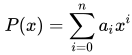
The constants ai are called the coefficients of the polynomial.
Each of the individual monomials in the above sum, whose coefficient ai ≠ 0, is called a term of the polynomial. When i = 0, xi = 1 and the corresponding term simply equals the constant ai. Also when i = 1, the corresponding term equals ai x.
A polynomial having two terms is called a binomial. A polynomial having three terms is called a trinomial.
Polynomial Equations[edit | edit source]
We refer to all functions with one independent variable as . Each instance of can be represented by an equation (either a monomial or a polynomial) which may have one or more places where the dependent variable is equal to zero. These places are called roots and they represent the number(s) whose value(s) for x make the function true. These roots are called the zeroes of the polynomial (singular is zero).

A polynomial of degree 1, will always look like a line when you graph it, and always has 1 real zero. A polynomial of degree 2, a quadratic function, can have 0, 1, or 2 real zeroes. A polynomial of degree 3 (a cubic function) can have 1 or 3 real zeroes. A polynomial of degree 4 can have 0, 2, or 4 real zeroes. Complex (unreal) zeroes, when present, always come in pairs. In general, a polynomial of degree n, where n is odd, can have from 1 to n real zeroes. A polynomial of degree n, where n is even, can have from 0 to n real zeroes.
When we graph polynomials each zero is a place where the polynomial crosses the x axis. A polynomial of degree one can be generically written as where M and C can be any real number. We will see that quadratic functions are curves. The curve can bend before it ever touches the X axis in which case it has no zeroes, It can bend just as it touches the X axis, in which case it can have just one zero, or it can open up above or below the X axis in which case it will have two zeroes. If you think about this you will see that polynomials with an odd degree (1,3,5, ...) have to be positive and negative, so they have to cross the X axis at least once. Polynomials with an even degree (2,4,6,....) might always be positive or negative and never have a zero.

Normally we represent a function in the form , but when we are looking for the roots of the function we want y to be equal to zero so we solve for the equation of where

| Order | Name | Number of bumps | Where found |
|---|---|---|---|
| 1 | linear | no bumps - straight line | straight line equations |
| 2 | quadratic | one bump | equations involving area and
vibrations |
| 3 | cubic | two bumps | equations involving volumes |
| 4 | quartic | three bumps | some physics equations (melting ice) |
| n (5+) | n-1 bumps | very rare |
Solving Polynomial Equations[edit | edit source]
Some polynomial equations can be solved by factoring, and all equations of degrees 1-4 can be solved completely by formulae. Above degree 4, there are no formulae for solving completely, and you must rely on numerical analysis or factoring. This means that for polynomials of degree greater than 4 it is often impossible to find exact solutions.
Rational roots of polynomial equations[edit | edit source]
Often we are interested in the rational roots of polynomials. A root is much like a factor of a number. For instance all even numbers have a factor of two. This means you can write the even numbers as two times another number. That is the numbers 2, 4, 6, 8 ... can be written as 2*1, 2*2, 2*3, 2*4 ... . This fact is helpful when you have a fraction of two even numbers. Given a fraction of two even numbers called N and M you could reduce the fraction by re-writing it as . By keeping fractions in lowest terms it's easier to know when you can add or subtract them without looking for a common denominator.


An example of a use of a polynomial equation[edit | edit source]
There is a story that in grade school the mathematician Gauss was asked to add the numbers 1 to 100 sequentially. He is said to have intuited the sum could be expressed with the formula n(n+1)/2 and quickly gave the answer 5050. The basis of this formula is that the numbers 1 through 49 added to the numbers 99 through 51 each yield 100. It is interesting to look at how this formula works for the values 9 and 10. For 10 we add the numbers 1+9, 2+ 8, 3+ 7, 4+ 6 to get 40 and we add the two remaining terms 5 and 10 to get 55. For 9 we add the terms 1 + 8, 2 + 7, 3 + 6, 4+ 5 to get 4*9 = 36 + 9 = 45. In the first case the n + 1 is the odd number and represents adding the 10 and the middle number, the 5. In the second case the n is the odd number and the n+1 represents the sum for the preceding terms in the formula. You may or may not find stories like this intriguing based on how your personality reacts to what is known as the foundational crisis of mathematics. Learning mathematics is a lot like learning a foreign language. Some people seem more adept at learning languages than others, but with hard work learning a new language is something we can all do.
Multiplying polynomials together[edit | edit source]
When we multiply polynomials together we rely heavily on the distributive property.
For instance when we multiply 67 by 5 we can divide the equation into (60 + 7)*5 = (300 + 35) = 335. Additionally we can apply the commutative property to multiply multidigit numbers. 67*25 = (60 + 7)(20 + 5) = ((60 + 7)*20) + ((60 + 7) *5) = (60*20) + (7*20) + (60*5) + (7*5) = 1200 + 140 + 300 + 35 = 1675. These properties are the foundation for the different forms of the mechanical calculating tool the abacus.
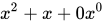
When multiplying polynomials together we do similar operations. We use the commutative property to divide the multiplier into its component parts and multiply the multiplicant by each of these parts. For instance to multiply by we first write the multiplicand and multiplier in terms of powers of x. This gives us and The terms raised to the zero power represent constant integer terms in our equations. Next we apply the commutative property to rewrite the equations as . We simplify these equations to be (notice how our integer term drops out). Finally we combine like terms to get the answer x^3 + 2x^2 + x +0x^0. Let's repeat that in the more familiar columnar format of multiplication:



![{\displaystyle [(x^{2}+x+0x^{0})*1x^{1}]+[(x^{2}+x+0x^{0})*1x^{0}]}](https://wikimedia.org/api/rest_v1/media/math/render/svg/dbba86651f1ab37affa8a2ff9bc66729cfe2b0da)
![{\displaystyle [x^{3}+x^{2}+0x^{1}]+[x^{2}+x+0x^{0}]}](https://wikimedia.org/api/rest_v1/media/math/render/svg/5599d47243b508084eb80282278ba556b5eabb97)
         1x^2 + 1x^1 + 0x^0
*               1x^1 + 1x^0
--------------------------
         1x^2 + 1x^1 + 0x^0
+ 1x^3 + 1x^2 + 0x^1
--------------------------
= 1x^3 + 2x^2 + 1x^1 + 0x^0 = x^3 + 2x^2 + x
By breaking a polynomial into its terms
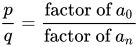
If we have a polynomial P(x)
The only possible rational roots (roots of the form p/q) are in the form
Binomials[edit | edit source]
binomial is a sum or difference of two monomials. These can also be called polynomials, but to specify, these are binomials.
Examples[edit | edit source]
2x + 2
2y - 7
How to factor[edit | edit source]
To factor binomials, find the greatest common factor between the terms and factor.
Example[edit | edit source]
4x + 2
The greatest common factor between these terms is 2 because both of the terms can be divided by it and the coefficient and constant is still an integer. The example factored would become:
2(2x+1)
External links[edit | edit source]
- Online interactive exercises on polynomials.