Algebra/Binomial Theorem

The notation ' ' is defined as n factorial.


0 factorial is equal to 1.

Proof of 0 factorial = 1
- When n = 1,
- And thus,



The binomial thereom gives the coefficients of the polynomial
- .

We may consider without loss of generality the polynomial, of order n, of a single variable z. Assuming set z = y / x

- .

The expansion coefficients of are known as the binomial coefficients, and are denoted

- .
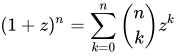
Noting that
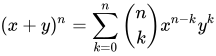
is symmetric in x and y, the identity
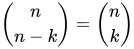
may be shown by replacing k by n - k and reversing the order of summation.
A recursive relationship between the may be established by considering


or
- .

Since this must hold for all values of z, the coefficients of on both sides of the equation must be equal

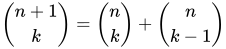
for k ranging from 1 through n, and
- .


Pascal's Triangle is a schematic representation of the above recursion relation ...
Show
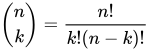
(proof by induction on n).
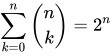
A useful identity results by setting

- .
The visual way to do the binomial theorem[edit | edit source]
(this section is from difference triangles)
Lets look at the results for (x+1)n where n ranges from 0 to 3.
(x+1)0 =          1x0           =                1
(x+1)1 =        1x1+1x0         =              1   1
(x+1)2 =      1x2+2x1+1x0       =            1   2   1
(x+1)3 =    1x3+3x2+3x1+1x0     =          1   3   3   1
This new triangle is Pascal’s Triangle.
It follows a counting method different from difference triangles.
The sum of the x-th number in the n-th difference  and
the (x+1)-th number in the n-th difference yields the
(x+1)-th number in the (n-1)-th difference.
It would take a lot of adding if we were to use the difference triangles in the X-gon to compute (x+1)10. However, using the Pascal’s Triangle which we have derived from it, the task becomes much simpler. Let’s expand Pascal’s Triangle.
(x+1)0                                    1
(x+1)1                                  1   1
(x+1)2                                1   2   1
(x+1)3                             1    3   3    1
(x+1)4                           1    4   6   4    1
(x+1)5                         1   5   10   10   5   1
(x+1)6                      1   6   15   20   15   6   1
(x+1)7                   1   7   21   35   35   21   7    1
(x+1)8                1   8   28   56   70   56   28   8    1
(x+1)9              1   9   36   84   126  126  84   36   9    1
(x+1)10          1   10  45   120  210  252  210  120  45   10    1
The final line of the triangle tells us that
(x+1)10 = 1x10 + 10x9 + 45x8 + 120x7 + 210x6 + 252x5 + 210x4 + 120x3 + 45x2 + 10x1 + 1x0.
Example Problems[edit | edit source]
Practice Problems[edit | edit source]
Problem 2: If 3! * 5! * 7! = n!, what is n?