Abstract Algebra/Sets and Compositions
A set is a grouping of values, and are generally denoted with upper-case letters. For instance, let's say that A is the set of all first names that start with the letter 'A'. From this definition, we can see that "Andrew" is a member of set A, but "Michael" is not.
Sets[edit | edit source]
Common Sets[edit | edit source]
Here are some of the common sets:
: The Natural Numbers : The Integers : The Rational Numbers : The Real Numbers : The Complex Numbers


The Natural Numbers are the set of non-negative and non-zero integers The Integers are all the natural numbers, their negative counterparts and zero . The Rational numbers are all the numbers that can be formed as a fraction of two integers with a non-zero denominator. The Real numbers include the rational numbers, and also includes all the numbers that cannot be formed as a ratio of two integers. The Complex numbers are all the numbers that involve the imaginary number, i. Notice that C can contain numbers that are imaginary (no real part), real (no imaginary part) and complex (real and imaginary parts).


Set Notation[edit | edit source]
Frequently, it is required that we define a set by a specific mathematical relationship. For instance, we can say that we want to define the set of all the even integers. Since is the set notation for integers, we can say:

In English, this statement says "All x in set such that x modulo 2 equals zero". Or, if we are not familiar with the modulo operation, it is perfectly acceptable to use plain English when defining our set:

The colon (:) here is read as "such that". This notation will come up a lot in the rest of this book, so it is important for the reader to familiarize themselves with this.
denotes that is an element of A.


Set Operations[edit | edit source]
A subset S of a set A is a set such that . This is denoted as .


The intersection of two sets A and B is the set .

The union of two sets A and B is the set .

If , the set .

Cartesian Product[edit | edit source]
A cartesian product between two sets shows the domains of two or more variables. For instance, if we have the variables x and y, and the sets A and B, we can use the cartesian product to show the domains of x and y in terms of A and B:

Compositions[edit | edit source]
Compositions are operations on a set that act on numbers of the set, and return a value that is in that same set, that is if is a set, a composition is a function


- For instance, addition between two integers produces an integer result. Therefore addition is a composition in the integers. Whereas division of integers is an example of an operation that is not a composition, since is not an integer.

If we have a set , we say that a composition acts on and produces a result in . This is also known as closure.

Associativity[edit | edit source]
A composition Δ is said to be associative if:

For instance, the addition operation is an associative operation over the integers, Z:

Notice however, that subtraction is not associative:

Commutativity[edit | edit source]
A composition Δ is said to be commutative if:

For instance, multiplication is commutative because:

Notice that division is not commutative:

Neutral Element[edit | edit source]
A Neutral Element (or Identity) is an item in E such that a composition in E E into E returns the other operand. For instance, say that we have a composition Δ, a neutral element , and a non-neutral element . If Δ is commutative, we have the following relation:



For instance, in addition, the neutral element is 0, because 1 + 0 = 1. Also notice that in multiplication, 1 is the neutral element, because 1 × 2 = 2.
Each composition may have only one neutral element, if it has any at all. To prove this fact, let's assume a composition Δ with two neutral elements, e and f:


But since e and f are commutative under Δ by definition, we know that e = f.
Ordered Pairs[edit | edit source]
Ordered pairs are artificial constructions where we set two values into a specific order. More formally, we can define an ordered pair as the set

Let's say that we have two ordered pairs, A and B, comprised of values and respectively:


We can see that if and only if


Functions[edit | edit source]
A function is essentially a mapping that connects two values, x and y. We use the following notation to show that our function f is a relationship between x and y:

Notice that x and y form an ordered pair: If we reverse the order of x and y, the relationship will be different (or non-existent). We say that the set of possible values for x is the domain, D, of the function, and the set of possible y values is the Range, R.
In other words, using some of the terms we have discussed already, we say that our function f maps from "D × R into R".
Inverses[edit | edit source]
If f is a function in D × R, to R, then f−1 is the inverse of f if it is in R × D to D, and the following relationship holds:

Exercise[edit | edit source]
- Of the four arithmetic operations, addition, subtraction, multiplication, and division, which are associative? commutative?
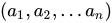
- Using the definition of the ordered pair as a model, give a formal definition for an ordered n-tuple:
Answer[edit | edit source]
| operation | associative | commutative |
|---|---|---|
| Addition | yes | yes |
| Multiplication | yes | yes |
| Subtraction | No | No |
| Division | No | No |