Abstract Algebra/Linear Algebra
The reader is expected to have some familiarity with linear algebra. For example, statements such as
- Given vector spaces and with bases and and dimensions and , respectively, a linear map corresponds to a unique matrix, dependent on the particular choice of basis.


should be familiar. It is impossible to give a summary of the relevant topics of linear algebra in one section, so the reader is advised to take a look at the linear algebra book.
In any case, the core of linear algebra is the study of linear functions, that is, functions with the property , where greek letters are scalars and roman letters are vectors.

The core of the theory of finitely generated vector spaces is the following:
Every finite-dimensional vector space is isomorphic to for some field and some , called the dimension of . Specifying such an isomorphism is equivalent to choosing a basis for . Thus, any linear map between vector spaces with dimensions and and given bases and induces a unique linear map . These maps are precisely the matrices, and the matrix in question is called the matrix representation of relative to the bases .


![{\displaystyle [f]_{\phi }^{\psi }\,:\,\mathbb {R} ^{n}\to \mathbb {R} ^{m}}](https://wikimedia.org/api/rest_v1/media/math/render/svg/7caafb343156d29880d26cfb58d4f0fc7f4abff2)


Remark: The idea of identifying a basis of a vector space with an isomorphism to may be new to the reader, but the basic principle is the same. An alternative term for vector space is coordinate space since any point in the space may be expressed, on some particular basis, as a sequence of field elements. (All bases are equivalent under some non-singular linear transformation.) The name associated with pointy things like arrows, spears, or daggers, is distasteful to peace-loving people who don’t imagine taking up such a weapon. The orientation or direction associated with a point in coordinate space is implicit in the positive orientation of the real line (if that is the field) or in an orientation instituted in a polar expression of the multiplicative group of the field.
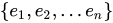
A coordinate space V with basis has vectors where ei is all zeros except 1 at index i.
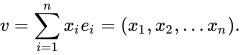
As an algebraic structure, V is an amalgam of an abelian group (addition and subtraction of vectors), a scalar field F (the source of the xi's), its multiplicative group F *, and a group action F * x V → V, given by
- The group action is scalar-vector multiplication.

Linear transformations are mappings from one coordinate space V to another W corresponding to a matrix (ai j ). Suppose W has basis

Then the elements of the matrix (ai j ) are given by the rate of change of yj depending on xi:
- constant.

A common case involves V = W and n is a low number, such as n = 2. When F = {real numbers} = R, the set of matrices is denoted M(2,R). As an algebraic structure, M(2,R) has two binary operations that make it a ring: component-wise addition and matrix multiplication. See the chapter on 2x2 real matrices for a deconstruction of M(2,R) into a pencil of planar algebras.
More generally, when dim V = dim W = n, (ai j ) is a square matrix, an element of M(n, F), which is a ring with the + and x binary operations. These benchmarks in algebra serve as representations. In particular, when the rows or columns of such a matrix are linearly independent, then there is a matrix (bi j ) acting as a multiplicative inverse with respect to the identity matrix. The subset of invertible matrices is called the general linear group, GL(n, F). This group and its subgroups carry the burden of demonstrating physical symmetries associated with them.
The pioneers in this field included w:Sophus Lie, who viewed the continuous groups as evolving out of 1 in all directions according to an "algebra" now named after him. w:Hermann Weyl, spurred on by Eduard Study, explored and named GL(n, F) and its subgroups, calling them the classical groups.