Abstract Algebra/Fields
Fields and Homomorphisms[edit | edit source]
Definition[edit | edit source]
- Definition (Field)
A field is a commutative unital ring such that every non-zero has a multiplicative inverse. In other words, for every there exists some such that .


Essentially, a field is a commutative division ring.
Examples[edit | edit source]
- (rational, real and complex numbers) with standard and operations have field structure. These are examples with infinite cardinality.
- , the integers modulo where is a prime, and and are mod is a family of finite fields.
- If is a field, then , the set of rational functions (i.e. quotients of polynomials), with coefficients in also forms a field.
- A non-example is where is not prime. For example, 2 in has no multiplicative inverse, hence is not a field.


Homomorphisms[edit | edit source]
- Definition (Field Homomorphism)
If are fields then is a field homomorphism if





Therefore a field homomorphism is exactly a unital ring homomorphism.
- Lemma 4.1.1
Every field homomorphism is injective.
Proof. This is a simple consequence of the ideal structure of fields. Suppose is a field homomorphism. In particular it is a ring homomorphism so we know that is a an ideal of . Since is a field, it only has trivial ideals so or . We can eliminate the second case since so the map cannot be trivial. Therefore we are in the first case which means exactly that is injective.


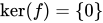


The above lemma means that every field homomorphism can also be thought of as an embedding of fields.
As happens so often in mathematics, a map between objects induces further maps between related objects. For example, a continuous map between topological spaces induces a map between the set of closed curves on the spaces and a linear map between vector spaces induces a linear map between the dual spaces (albeit in the opposite direction). In this case, a homomorphism between fields induces a homomorphism between the corresponding ring of polynomials. To be precise, suppose is a field homomorphism. This induces a map given by

![{\displaystyle \varphi _{*}:E[x]\to F[x]}](https://wikimedia.org/api/rest_v1/media/math/render/svg/21e6350c28b768e35b40a45fddaaf688e058171d)

It is easy to see that is a (unital) ring homomorphism. Moreover if is an isomorphism then so is .


Characteristic of Fields[edit | edit source]
An important property of fields is their characteristic. We first need to consider the canonical homomorphism from into a field . Of course this is defined by mapping the unit to the unit. Since is generated by , this is sufficient to define the entire homomorphism. From the First Isomorphism Theorem, we know that . In particular, this means that is a subring and even a subfield of so is an integral domain. Hence is a prime ideal of . There is a unique non-negative integer generating this ideal. We call this integer the characteristic of . Notice by the above argument that the characteristic must be prime if it is non-zero.





Intuitively, the characteristic of a field is the smallest positive integer , if one exists, such that
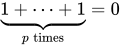


Sometimes, one calls the image of under the above canonical homomorphism above the prime subfield of . Hence the prime subfield of a finite field is (isomorphic to) (where is the characteristic of ) and the prime subfield of a field of characteristic 0 is (isomorphic to) .

Field Extensions[edit | edit source]
- Definition (Field Extensions)
Let and be fields. If and there is an embedding from into , then is a field extension of .


Let be an extension of . Since we can scale elements of by elements of via the multiplication on , forms a vector space over (one can verify all the axioms for vector spaces hold). The dimension of this vector space is the degree of the extension, . If the degree is finite, then is a finite extension of , and is of degree over F.
![{\displaystyle [G:F]}](https://wikimedia.org/api/rest_v1/media/math/render/svg/ad27270a25d44f2234940928168d7cdc845e2f1e)
![{\displaystyle n=[G:F]}](https://wikimedia.org/api/rest_v1/media/math/render/svg/a67c5890d5adcd4b611301ba168c42abd5c3d6ad)
Examples[edit | edit source]
- The complex numbers are a field extension of the real numbers . The extension is of degree 2.
- Similarly, one can add the imaginary number to the field of rational numbers to form the field of Gaussian rationals. This is also a degree 2 extension.
- The real numbers form a field extension over but this is not a finite extension since the real numbers do not form a finite dimensional (or even a countably infinite dimensional) vector space over .


Algebraic Extensions[edit | edit source]
- Definition (Algebraic Extensions)
Let be an extension of . Then is algebraic over if there exists a non-zero polynomial such that . is an algebraic extension of if is an extension of , such that every element of is algebraic over .


![{\displaystyle f(x)\in F[x]}](https://wikimedia.org/api/rest_v1/media/math/render/svg/1dda9c7789a0909d246d4eb124548e07646fd4e3)

For example, is an algebraic extension over (if is any element of then it is a root of ) but is not algebraic over because for example is not the root of any rational polynomial (this is a very difficult statement to prove).




- Definition (Minimal Polynomial)
If is algebraic over then the set of polynomials in which have as a root is an ideal of . This is a principle ideal domain and so the ideal is generated by a unique monic non-zero polynomial, . We define the to be the minimal polynomial.

![{\displaystyle F[x]}](https://wikimedia.org/api/rest_v1/media/math/render/svg/39bc9f9d8679fc385df3bccf9694283b796f3216)

For example, the minimal polynomial of is and the minimal polynomial of is , both over . Note the minimal polynomial is heavily reliant on the field it is being viewed over. The minimal polynomial of over is simply .

![{\displaystyle {\sqrt[{3}]{2}}}](https://wikimedia.org/api/rest_v1/media/math/render/svg/9ca071ab504481c2bb76081aacb03f5519930710)

![{\displaystyle x-{\sqrt[{3}]{2}}}](https://wikimedia.org/api/rest_v1/media/math/render/svg/f041f5dd24b5776a42c897433dcecf51097e8b06)
Splitting Fields[edit | edit source]
Our primary goal in this study is to find the roots of a given polynomial. The brilliant insight of Galois and Galois theory is to (try to) answer this question by looking at field extensions. The following two lemmas might help motivate this reasoning.
- Lemma 4.1.2
Suppose is a field is a polynomial. Then there exists a (finite) field extension of such that contains a root of .

Proof. Suppose first that is irreducible. Then we can take . We know that is indeed a field because is irreducible. Moreover it contains an isomorphic copy of as the (equivalence classes of) the constant polynomials. Finally , the equivalence class of the linear polynomial , is a root of since
![{\displaystyle E=F[x]/(f(x))}](https://wikimedia.org/api/rest_v1/media/math/render/svg/747e8f64f76a514e7523699e11f5fe6ad5722ad8)
![{\displaystyle [x]}](https://wikimedia.org/api/rest_v1/media/math/render/svg/07548563c21e128890501e14eb7c80ee2d6fda4d)
![{\displaystyle f([x])=[f(x)]=0\in F[x]/(f(x))}](https://wikimedia.org/api/rest_v1/media/math/render/svg/90ec59d964c9dbf4a0dcf7edc724709379dff77d)




![{\displaystyle [g(x)]}](https://wikimedia.org/api/rest_v1/media/math/render/svg/df7ce0a7fa0749be54ee5e84922710d356d98cb6)

![{\displaystyle \{1,[x],[x^{2}],\dots ,[x^{n-1}]\}}](https://wikimedia.org/api/rest_v1/media/math/render/svg/df63633a84015e7a6ee2ccef3cb396c728700b95)
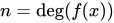
We know is irreducible over , therefore is a field and one can verify that this field is isomorphic to . In fact, sometimes one defines the complex numbers as this quotient .
![{\displaystyle \mathbb {R} [x]/(x^{2}+1)}](https://wikimedia.org/api/rest_v1/media/math/render/svg/9d0ade67281f83ef6b6b7f43bf783c081adb1fc3)
- Lemma 4.1.3
Suppose is an extension over . Let be an irreducible polynomial in such that contains , a root of . Let be the smallest subfield of containing and . Then .


![{\displaystyle F(\alpha )\cong F[x]/(f(x))}](https://wikimedia.org/api/rest_v1/media/math/render/svg/0a5a8cee054dd767f9799b718e45d7614c9eb3e9)
Proof. By the smallest subfield containing and , we mean the intersection of all subfields of that contain them. This collection of fields is non-empty since it contains for instance and it is easy to see that the intersection of subfields is again a subfield.
If is of degree 1, then we are done since that would mean that so and by the argument towards the end of Lemma 4.1.1, we have . Then we can assume that .


![{\displaystyle F[x]/(f(x))\cong F}](https://wikimedia.org/api/rest_v1/media/math/render/svg/3e4674b0843e4f43bd68b77595467ecff8f9c185)
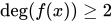
In order to show the isomorphism, we define a ring homomorphism
![{\displaystyle {\begin{aligned}\varphi :F[x]&\to F(\alpha )\\g(x)&\mapsto g(\alpha )\end{aligned}}}](https://wikimedia.org/api/rest_v1/media/math/render/svg/10f94d69574b267c0077977d34fc352b26f2f9c2)
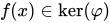

![{\displaystyle F[x]/(f(x))}](https://wikimedia.org/api/rest_v1/media/math/render/svg/197e7155dc6131aed2b7a55be0b5e165e3794259)
![{\displaystyle F[x]/(f(x))\cong F(\alpha )}](https://wikimedia.org/api/rest_v1/media/math/render/svg/26def47dd5c511d18177023234d214e9afa50e50)
The first lemma above tells us that we can always find a field extension containing the root of an irreducible polynomial by modding out by the polynomial. The second lemma tells us that any field extension containing a solution is of this form (up to isomorphism). Thus we will spend considerable time looking at the ring of polynomials over a field and studying its quotient spaces.
One often thinks of as 'adjoining' the root to the field . Roughly speaking, we add to the field and then we close it under the field operations by also adding in all the possible sums, products, inverses, etc. and the further condition that satisfies the given polynomial. In fact, this is precisely what the construction in the previous lemma does.
An important consequence of Lemma 4.1.3 is that the roots of an irreducible polynomial are algebraically indistinguishable (this is made precise in Theorem 4.1.4 and in particular by its Corollary 4.1.5). For example, we know that and are both solutions of . There is no algebraic distinction between the two roots; to differentiate them we need topological information like the fact that and . Similarly, and are both solutions to . Interchanging these roots is exactly what leads to complex conjugation. The fact that roots of (irreducible) polynomials are all equivalent to one another is one of the key ideas of Galois Theory.


- Theorem 4.1.4
Let be fields and be an irreducible polynomial. Let be an isomorphism of fields. Let be the polynomial . Let be a root of (in some extension of ) and let be a root of (in some extension of ). Then there exists an isomorphism that agrees with on .



Proof. Since is an isomorphism and is irreducible, we must have is also irreducible (since if we had then which would contradict irreducibility of ). Then and generate maximal ideals in their respective rings and the ring isomorphism descends to an isomorphism (of fields) of the quotients


![{\displaystyle F[x]/(f(x))\to {\widetilde {F}}[x]/({\widetilde {f}}(x))}](https://wikimedia.org/api/rest_v1/media/math/render/svg/a25cb61ad06228846d687a0f390e42c5e08d81be)

- Corollary 4.1.5
Let be fields and be an irreducible polynomial. Suppose are roots of in some (potentially different) extensions of . Then .

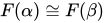
Proof. Apply the previous theorem to case with and as the identity map.

- Definition (Splitting Field)
Let be a field, and are roots of . Then the smallest field extension of which contains is called a splitting field of over . In other words, no proper subfield of contains and all .



Existence and Uniqueness of Splitting Fields[edit | edit source]
We will see that rather than looking at arbitrary field extension, splitting fields will be the things to consider. First we need to know that they always exist.
- Theorem 4.1.6
Let be a field and a polynomial. Then there exists a field extension of that is a splitting field of .
Proof. This is a largely uninteresting case of proof by induction. We will induct on the degree of . If is linear, then clearly its roots (in fact just the one root) is contained in so itself is a splitting field. Suppose . If splits into the product of linear terms, then again all the roots are contained in , so we already have a splitting field. So suppose has an irreducible factor of degree at least 2. Then there exists a field extension containing a root of . Then in , we can factorise the polynomial into where is a polynomial of degree . Then by induction there exists a field extension of that is a splitting field of . Therefore is a field extension of that contains all the roots of . Taking the intersection of all subfields of containing and the roots of gives us , a splitting field of .
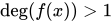



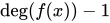

Above we were careful to say a splitting field of . In fact, this was an unnecessary precaution since the splitting field of a polynomial is unique up to isomorphism. This follows from a generalisation of Theorem 4.1.4, where we claim the statement of the theorem holds even if we adjoin all the roots of the polynomial, instead of just one.
- Theorem 4.1.7
Let be fields and be a polynomial. Let be an isomorphism of fields. Let be the polynomial . Let a splitting field of and a splitting field of . Then there exists an isomorphism that agrees with on .


Proof. This is once again a proof by induction on the degree of . If is of degree 1 or indeed splits into factors of degree 1 then the splitting field of is so we can take . Thus suppose has an irreducible factor of degree at least 2 so is an irreducible factor of . Then by the previous theorem we know extends to an isomorphism where is a root of and is a root of . Therefore over and respectively we can write and . Notice that is a splitting field of over . Indeed if a splitting field was strictly contained within , then it would contain all the roots of and and hence would contain all the roots of . But this would contradict being a splitting field of . Of course the same holds true for over . Since and have degree strictly less than , by induction we can assume that the statement of theorem holds for them. In particular, extends to an isomorphism . But since was an extension of , must also be an extension of concluding the proof.








- Corollary 4.1.8
Let be a field and be a polynomial. If are splitting fields of , then they are isomorphic.

Proof. Apply Theorem 4.1.7 to the case with and as the identity map.
Classification of Finite Fields[edit | edit source]
- Theorem 4.1.9
If is a finite field, then for some prime and natural number .

Proof. Since is a finite field and we know its prime subfield is for some prime . The prime subfield is in particular a subfield of and hence forms a vector space over . Since is finite, it must be a finite dimensional vector space and in particular we must have have for some (as vector spaces) so .

Theorem (every member of F is a root of )[edit | edit source]

let be a field such that , then every member is a root of the polynomial .

proof: Consider as a the multiplicative group. Then by la grange's theorem . So multiplying by gives , which is true for all , including .




Theorem (roots of are distinct)[edit | edit source]

Let be a polynomial in a splitting field over then the roots are distinct.
