A-level Mathematics/OCR/FP1/Roots of Polynomial Equations
In this module we will discuss how symmetrical polynomial have special relationships with their roots. This characteristics make it easier to find the roots of a symmetrical polynomial or multiply factors together.
Symmetrical Polynomials[edit | edit source]
In mathematics a polynomial is considered to be symmetrical if you take the roots of the original polynomial and then interchange any root with another root, the polynomial will remain the same. For example the polynomial is symmetrical because its factorized form is and if you interchange the roots the resulting polynomial will be the same. However the polynomial is not symmetrical because it factorized form is and if you interchange the roots the resulting polynomial will be if you switch the 2 and the 5 around.





Roots Of Quadratic Polynomial[edit | edit source]
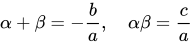
If we need to find the roots of a given quadratic function we have two formulae that can help us to find the roots of a quadratic equation.
Let and be the roots of . Then,



Example[edit | edit source]
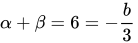
Find the values of a and b of the equation if and .
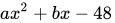


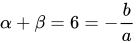
- First we need to find the value of a and b, we use the relationships of the roots to find a and b.
- from this we can determine that a = 3
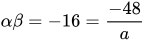
- Now that we have determined that a = 3 we can write the second relationship as:
- so we can determine that b = -18
- Now we can write the complete equation.

Roots Of Cubic Equations[edit | edit source]
If we need to find the roots of a given cubic function we have three formulae that can help us to find the roots of a cubic equation.
Let and be the roots of . Then,




Where:
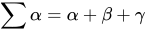
And:

Example[edit | edit source]
In this example we consider the special case of the cubic , where c is to be determined and we are given the additional information that its 3 roots are in arithmetic progression. Thus we can write the roots in the form p, p + q, p - q. Also factorize the equation.

- First to find p we use the .
- Then we need to find the value of q.
- Now we can write out our roots.
- (-7 - 3),-7,(-7 + 3)
- -10,-7,-4
- We can now find c.
- The complete equation is
- Finally we write out the factorized equation.












Simple Substitution of Roots[edit | edit source]
If you increase each root in a polynomial equation by the number n, you can calculate the resulting equation by replacing each x term in the original polynomial equation with (x - n). This leads to binomial expansion so make sure that you are well versed in it.
Example[edit | edit source]
Suppose that the cubic equation has roots and . Find a cubic equation with the roots and



- If then . Since is a root of the original equation you can replace each x term with x + 2:
- Using Binomial Expansion we can easily find the terms.
- Finally we combine all the terms and we have:




This is part of the FP1 (Further Pure Mathematics 1) module of the A-level Mathematics text.