The relations between the roots and the coefficients of a polynomial equation; the occurrence of the non-real roots in conjugate pairs when the coefficients of the polynomials are real.


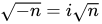
Square root of any negative real number[edit | edit source]

General form of a complex number[edit | edit source]

where  and
and  are real numbers
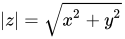
Modulus of a complex number[edit | edit source]
Argument of a complex number[edit | edit source]
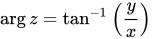
The argument of  is the angle between the positive x-axis and a line drawn between the origin and the point in the complex plane (see [1])


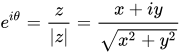
Polar form of a complex number[edit | edit source]



Addition, subtraction and multiplication of complex numbers of the form x + iy[edit | edit source]
In general, if  and
and  ,
,





Division of complex numbers of the form x + iy[edit | edit source]
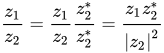
Products and quotients of complex numbers in their polar form[edit | edit source]
If 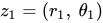 and
and 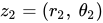 then
then  , with the proviso that
  may have to be added to, or subtracted from,
  if is outside the permitted range for
  .
.
If and then 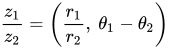 , with the same proviso regarding the size of the angle
  .
.
Equating real and imaginary parts[edit | edit source]

Coordinate geometry on Argand diagrams[edit | edit source]
If the complex number  is represented by the point
  , and the complex number
  is represented by the point
  in an Argand diagram, then
  , and
, and 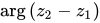 is the angle between
  and the positive direction of the x-axis.
 represents a circle with centre
  and radius
 represents a circle with centre and radius
 represents a straight line — the perpendicular bisector of the line joining the points and
 represents the half line through inclined at an angle
  to the positive direction of
 represents the half line through the point inclined at an angle to the positive direction of
De Moivre's theorem and its applications[edit | edit source]

De Moivre's theorem for integral n[edit | edit source]
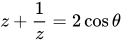

Exponential form of a complex number[edit | edit source]



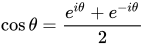
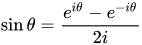
The cube roots of unity are  ,
,  and
and  , where


and the non-real roots are

The equation  has roots

The roots of zn = α where α is a non-real number[edit | edit source]
The equation  , where
  , has roots

Definitions of hyperbolic functions[edit | edit source]
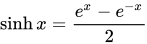
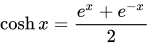
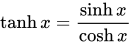
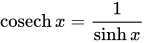
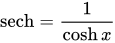
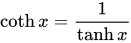






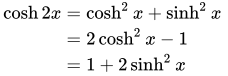
Osborne's rule states that:
- to change a trigonometric function into its corresponding hyperbolic function, where a product of two sines appears, change the sign of the corresponding hyperbolic form
Note that Osborne's rule is an aide mémoire, not a proof.
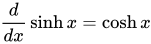
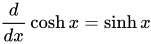
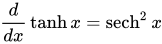
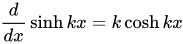
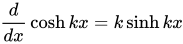
Differentiation of hyperbolic functions[edit | edit source]

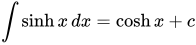
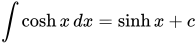
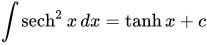
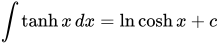
Integration of hyperbolic functions[edit | edit source]
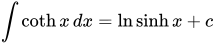
Inverse hyperbolic functions[edit | edit source]
Logarithmic form of inverse hyperbolic functions[edit | edit source]


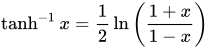
Derivatives of inverse hyperbolic functions[edit | edit source]
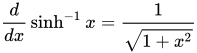
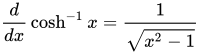

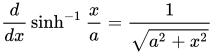
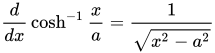
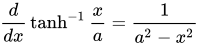
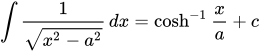
Integrals which integrate to inverse hyperbolic functions[edit | edit source]
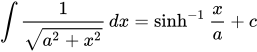

Arc length and area of surface of revolution[edit | edit source]
Calculation of the arc length of a curve and the area of a surface using Cartesian or parametric coordinates[edit | edit source]


The AQA's free textbook [2]